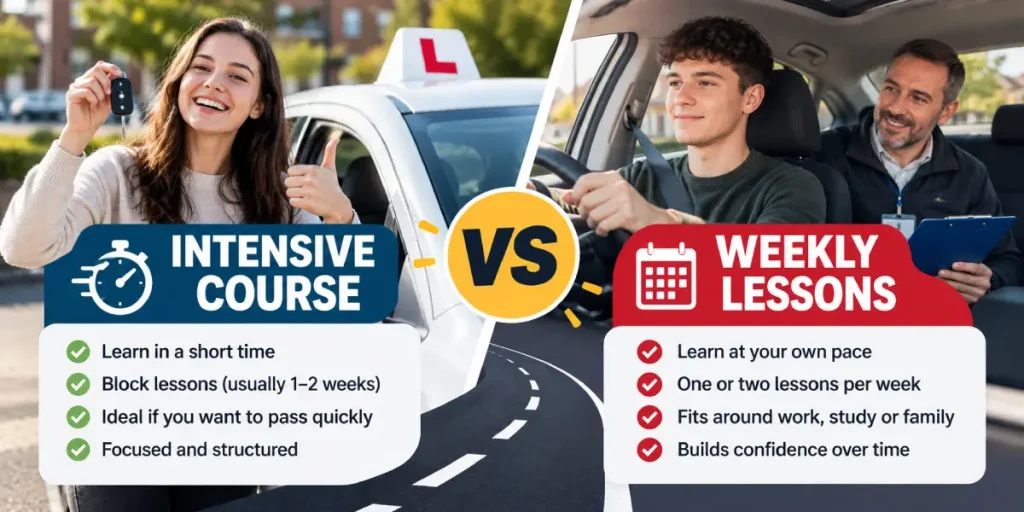
Here’s the honest answer up front, because the industry rarely gives it to you straight. For most complete beginners, weekly lessons produce a better result for similar or lower total cost. Intensive courses are excellent, but for a specific set of people and reasons: a hard deadline, an upgrade to your licence, or a genuine struggle with stop-start weekly progress. Speed is what they sell, not superior teaching.
This guide compares the two properly, what each actually costs, how long each takes, who each suits, and one 2026 change to test booking that makes the intensive timing trickier than it used to be. By the end you’ll know which fits your situation, not just which sounds fastest.
The core difference
Weekly lessons spread your learning over months. You take one or two lessons a week, usually an hour or two at a time, and build up gradually over roughly three to nine months.
Intensive courses (sometimes called crash courses) compress that same learning into consecutive full days, typically one to two weeks, driving six or so hours a day, often with your practical test booked for the end.
The total number of hours behind the wheel is broadly similar either way. What changes is how those hours are spread, and that turns out to matter more than it sounds.
Why compressed learning is genuinely harder
This is the part the “pass in a week!” adverts skip, and it’s not marketing spin, it’s how learning works.
Driving is a motor skill, like playing an instrument or a sport. Motor skills consolidate during sleep. Practise, sleep, and your brain quietly files what you learned; come back and it’s more secure. That’s why a skill you found impossible on Monday often feels easier on Wednesday without any extra practice in between. Cram everything into consecutive days and you get far fewer of those overnight consolidation gaps, so more of the learning has to happen in the moment, under fatigue.
None of that makes intensives bad. Plenty of people pass through them very successfully. But it explains why, for a nervous beginner starting from zero, the drip-feed of weekly lessons with practice in between often reaches a more solid, test-ready standard than the same hours crammed into ten days. You’re working with how your brain learns, not against it.
What each actually costs
Let’s be clear about the money, because “intensive saves you money” is only sometimes true.
Intensive courses are not cheaper per hour. Across the UK in 2026, intensive packages typically run from around £900 up to £1,800+ for a beginner course of roughly 30 to 40 hours, which works out to a similar or slightly higher hourly rate than standard lessons. The package price simply bundles the hours, course management and often the test booking into one figure.
Weekly lessons at MS Driving Academy are £35 an hour, or £320 for a ten-hour block. A typical beginner needing around 45 hours is looking at roughly £1,440 in lessons spread over months, an amount you barely notice going out at £35 a week.
Here’s the honest comparison for a complete beginner:
| Weekly lessons | Intensive course | |
|---|---|---|
| Spread | 3 to 9 months | 1 to 2 weeks |
| Typical hours | ~45 | ~30 to 40 |
| Rough tuition cost | ~£1,440 at £35/hr | ~£900 to £1,800 |
| Private practice between sessions | Yes, easily | Rarely |
| Overnight consolidation | Plenty | Little |
Two costs the adverts gloss over. First, many beginners need a top-up of 5 to 10 extra hours after an intensive to be genuinely ready, which closes any price gap. Second, the retake risk: lots of intensive packages include only one test attempt, so a fail means another £62 to £75 test fee plus more hours, which can push the total well above a weekly-lesson programme. Failing an intensive is more expensive than failing off weekly lessons.
A word on “guaranteed pass” and pass-rate claims
If a provider advertises a “guaranteed pass” or a headline pass rate, ask one question: is that rate for everyone who paid, or just for those who reached the test? A course can post a flattering number by only counting people who got as far as sitting the test. If they won’t share the first figure, treat the second with caution. And be wary of any “guaranteed pass” that isn’t backed by qualified DVSA-approved instruction, it’s a marketing phrase, not a promise the DVSA recognises.
The 2026 test-booking change you need to factor in
This is new, and it affects intensive courses specifically.
Waiting times for practical tests have been long, and the DVSA has brought in rules to curb the booking bots that made it worse. From 2026, there are tighter controls on car practical test bookings, including limits on how many times you can change a test and restrictions designed to stop bulk-booking of slots.
Why it matters for you: some intensive providers historically relied on holding test slots to offer a course “with a test at the end”. With slots harder to grab and hold, and waits still long in busy areas, the test date is often the real bottleneck, not the learning. A course that promises a test in two weeks can’t conjure a slot that isn’t there. Around East London this is especially live, because the Barking test centre closed in January 2026 and demand shifted to Goodmayes and Wanstead.
The practical takeaway: whichever route you choose, get your theory passed early and book your practical as soon as you can. Don’t let anyone sell you a timeline the calendar can’t deliver.
So which should you choose?
Match yourself to the honest picture:
| Weekly lessons suit you if… | An intensive course suits you if… |
|---|---|
| You’re a complete beginner with no hard deadline | You have a firm deadline: a job start, a move, a course requirement |
| You want the most solid, test-ready standard for your money | You already drive: upgrading an automatic licence to manual, or reactivating a lapsed licence |
| You have access to a car for private practice | You’ve genuinely struggled with weekly stop-start progress and do better with immersion |
| You’d rather spread the cost gently over months | You can absorb the bigger financial hit if you need to rebook |
| You learn steadily, a bit at a time | You can commit to full, tiring days back to back |
A useful rule of thumb: if you’re a first-time learner and the only reason you’re drawn to an intensive is that it “sounds quicker”, weekly lessons are probably the better call. If you have a real deadline or you already have driving experience to build on, an intensive can be exactly right.
And it isn’t strictly either/or. A semi-intensive approach, several longer lessons a week over a few weeks, sits between the two and works well for people who want to move quickly but still get some consolidation time. If you’re not sure, that middle path is often the sensible answer.
Frequently asked questions
Is an intensive course cheaper than weekly lessons?
Not usually. Per hour it’s similar or slightly more. The total can occasionally be lower, but top-up hours and the cost of rebooking a failed test often erase any saving. You pay mainly for speed, not for a lower price.
How long is an intensive driving course?
Typically one to two weeks for a beginner, driving around six hours a day, with roughly 30 to 40 hours in total. Shorter courses suit people who already have experience.
Do I need to pass my theory test before an intensive course?
Almost always, yes. Most providers require you to have passed theory so they can book your practical for the end of the course. Sort your theory first.
Are intensive courses harder than weekly lessons?
The learning is more demanding because it’s compressed, with little overnight consolidation and full days of concentration. Many people pass through them well, but complete beginners often reach a more solid standard through weekly lessons.
Can I get a test date quickly for an intensive course?
Not guaranteed. Test waits are long in many areas and 2026 booking rules limit slot-grabbing, so the test date is often the real constraint. Book early and be realistic.
What’s the best option if I’m nervous?
Usually weekly lessons, which let you build confidence gradually with practice in between. A semi-intensive can also work. A pure crash course is the toughest route for an anxious beginner.
Not sure which is right for you?
The honest answer depends on your deadline, your experience and how you learn, and you shouldn’t have to guess. At MS Driving Academy we offer both weekly lessons (£35 an hour, £320 for a ten-hour block) and intensive courses across Barking and East London, and we’ll tell you straight which suits your situation, even when that’s the cheaper option for you.
Tell us your timeline and where you’re starting from, and we’ll build a realistic plan around an achievable test date rather than a promise the calendar can’t keep.
Book Your First Lesson · Ask About Intensive Courses

Shurat Rahman is a DVSA Approved Driving Instructor (ADI) at MS Driving Academy, with three years’ experience teaching manual and automatic lessons across Barking, Ilford and East London. He regularly prepares learners for practical tests at Goodmayes, Chingford, Wanstead, Loughton and Hornchurch.