Feeling nervous about your first driving lesson? Good news: that’s completely normal, and it’s about to feel a lot less daunting. The vast majority of new learners are anxious before their first lesson, and almost all of them get out of the car an hour later grinning, because the reality is far gentler than the build-up in your head.
Here’s the reassuring headline. You will not be thrown into busy traffic. You won’t be expected to know anything. Your instructor will drive you somewhere quiet, walk you through the car step by step, and by the end of the hour you’ll have driven a car for the first time, even if only at walking pace down an empty road. This guide talks you through exactly what happens, so you can turn up calm and ready.
Before the lesson: what to sort out
A little preparation makes the whole thing smoother.
- Your provisional licence. You must have it before you can drive, and your instructor will need to see it. Bring the physical card.
- Glasses or contacts, if you need them to read a number plate at 20 metres. There’s a quick eyesight check at the start.
- Comfortable, flat shoes. Chunky boots, heels or flip-flops make the pedals harder to feel. Trainers are ideal.
- A calm, curious mindset. You’re a student, not being tested. Nobody expects you to know how to drive yet. That’s the whole point of being there.
One common question worth settling: you do not need to have passed your theory test before your first lesson. You only need your provisional. In fact, learning practical skills and revising theory at the same time helps both sink in, because road signs and hazards make far more sense once you’ve been on the road.
Minute by minute: what actually happens
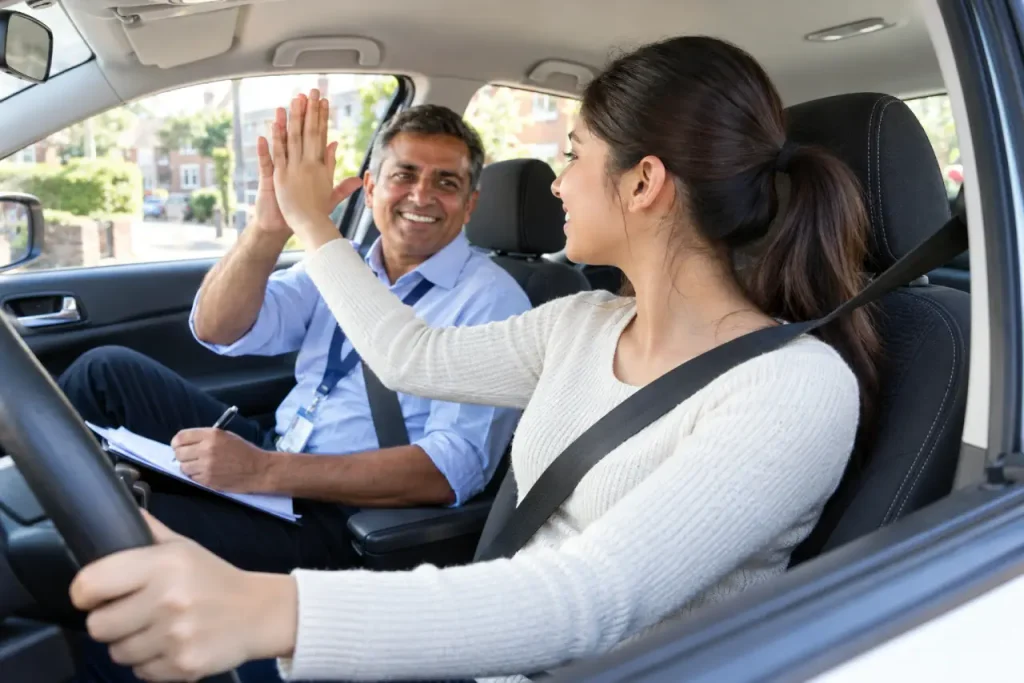
Every DVSA-approved instructor follows a similar structure for a first lesson. Here’s the shape of it.
1. Meeting and legal checks (a few minutes)
Your instructor introduces themselves, puts you at ease, and checks your provisional licence. They’ll do a quick eyesight check, asking you to read a number plate from about 20 metres. Then a short chat about any previous experience and what you’d like to get out of your lessons. This is a good moment to mention if you’re nervous. They’ve heard it a hundred times and it genuinely helps them pitch the lesson to you.
2. Driving to a quiet spot (you’re still the passenger)
Your instructor drives you to a quiet residential road or a nursery area with little traffic. On the way, they might talk through what they’re doing at the controls, and point out that there’s a second set of pedals on your side (dual controls) that let them keep you safe. You won’t touch anything yet. This removes the traffic variable so that when it’s your turn, you can focus entirely on the car.
3. The cockpit drill (setting yourself up)
Once parked somewhere safe, you swap into the driver’s seat and learn the cockpit drill, the routine you’ll do every single time you get in a car. Instructors often call it DSSSM:
- Doors closed and secure
- Seat adjusted so you can reach the pedals comfortably
- Steering wheel and position set
- Seatbelt on (legally required before you start the engine)
- Mirrors adjusted for the best view and minimal blind spots
It sounds like a lot written down. In the car, with someone showing you, it takes a couple of minutes and quickly becomes second nature.
4. Getting to know the controls
Next, your instructor runs through the controls with you: the pedals, the gears, the indicators, lights and wipers, and the handbrake. In a manual, this is where you’ll first hear about the clutch and the biting point, which is the thing everyone worries about and everyone gets the hang of. In an automatic, it’s simpler: essentially go and stop. Good instructors make this a conversation, asking you questions and involving you, rather than a lecture.
5. Moving off and stopping (the real bit)
Here’s where it becomes real. You’ll learn the routine for moving off from the side of the road, drive a short distance, then pull back in and stop. Then you’ll do it again. And again. By the end of the lesson you’ll have done several of these move-off-and-stop cycles on a quiet road.
That’s genuinely it for lesson one. Moving off, a short drive, stopping, repeated until it starts to feel less alien. It’s not glamorous, but it’s the foundation everything else is built on, and doing it in a calm, empty street is exactly how it should be.
6. A quick recap
At the end, your instructor will give you a bit of feedback, tell you what went well, and outline what’s next. If you’re learning with MS Driving Academy, this all gets logged in the MS Smart Drive app, so you can see your progress from lesson one.
You will make mistakes, and that’s the plan
Let’s take the pressure off completely: you are expected to make mistakes on your first lesson. Every instructor knows it and plans for it.
If you’re in a manual, you will probably stall. Everyone does. It’s not dangerous, it’s not embarrassing, and it’s not a sign you’re bad at this. It’s just what happens while your foot learns the clutch. Your instructor stays calm, talks you through the restart, and you carry on. You might also steer too much at low speed, or lift off the brake a bit sharply. All normal, all harmless on a quiet street with no other cars around, and all exactly why first lessons happen there rather than on a main road.
The single best mindset: curiosity, not performance. You’re not there to impress anyone. You’re there to learn, and mistakes are how that works.
How long is the first lesson, and what comes next?
Most first lessons last one to two hours. An hour is plenty to cover the basics without frying your concentration; some people prefer a two-hour first lesson to get more time behind the wheel. Your instructor can advise what suits you.
After the first lesson, you’ll build up gradually: more time moving off and stopping, then junctions, then roundabouts and busier roads, then manoeuvres, and eventually independent driving and test preparation. Nobody expects you to remember it all at once. It’s layered on slowly, and it genuinely does become second nature.
Frequently asked questions
Do I need to pass my theory test before my first driving lesson?
No. You only need a valid provisional licence for your first lesson. You must pass theory before you book your practical test, but not before you start learning.
Will I actually drive on my first lesson?
Yes. After the checks and the cockpit drill, you’ll move off and stop several times on a quiet road. You won’t be put into busy traffic, but you will drive the car.
What should I wear and bring?
Comfortable flat shoes (trainers are perfect), your provisional licence, and glasses or contacts if you need them to see at a distance. That’s it.
What if I stall or make a mistake?
Completely expected, especially in a manual. Your instructor stays calm, helps you restart, and you keep going. Mistakes are a normal part of a first lesson, not a problem.
How long does a first driving lesson last?
Usually one to two hours. One hour comfortably covers the basics; two hours gives you more driving time if you’d prefer.
Do I need any experience beforehand?
None at all. Your instructor assumes you’ve never driven and guides you through everything from scratch.
Ready for your first lesson?
Now that you know what’s coming, the nerves should feel a lot smaller. A calm instructor, a quiet road, and a couple of simple things to learn. That’s your first lesson.
At MS Driving Academy, our DVSA-approved instructors specialise in making nervous beginners feel at ease from the very first minute, across Barking and East London. Lessons are £35 an hour, or £320 for a ten-hour block, and you can track your progress from day one in the MS Smart Drive app.
Book Your First Lesson · Download the MS Smart Drive App

Shurat Rahman is a DVSA Approved Driving Instructor (ADI) at MS Driving Academy, with three years’ experience teaching manual and automatic lessons across Barking, Ilford and East London. He regularly prepares learners for practical tests at Goodmayes, Chingford, Wanstead, Loughton and Hornchurch.