Passing your theory test first time comes down to three things: knowing exactly what the DVSA tests, practising the official questions until you score comfortably above the pass mark every time, and treating hazard perception as a skill you drill rather than a quiz you wing. Do those three, and you’ll be in the half of candidates who pass. Skip the preparation, and the numbers are not on your side.
Because here is the reality most people underestimate. The theory test is not a formality you breeze through on the way to the practical. The first-time pass rate is under 50%, which means roughly half of everyone who sits it has not prepared enough. This guide covers exactly how the test works, what changed in 2026, and the revision routine that puts you in the passing half.
How the theory test works
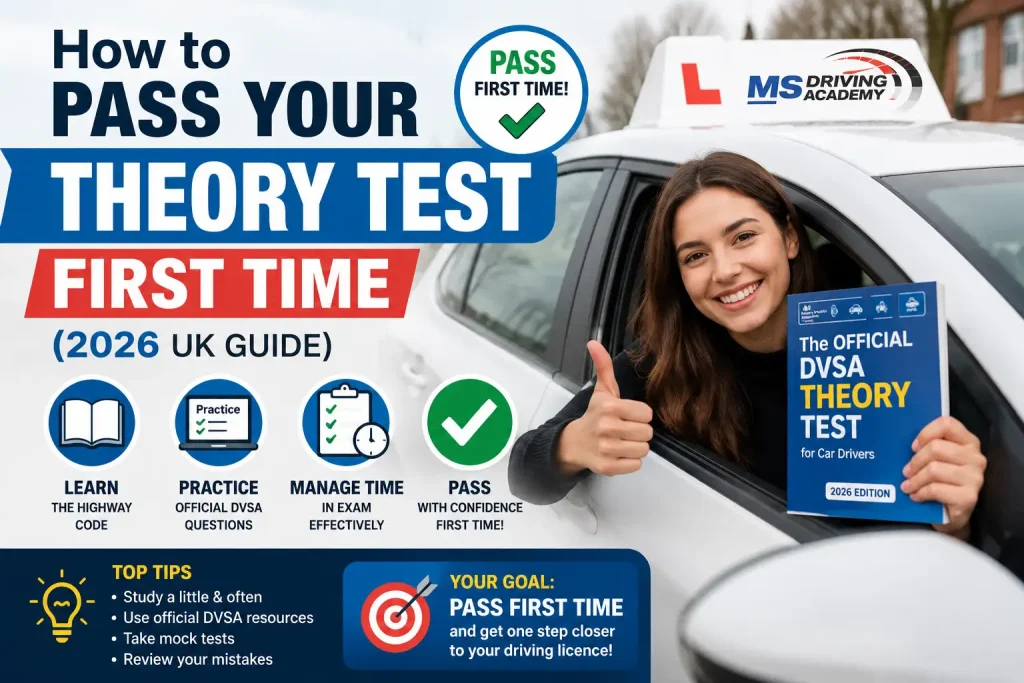
The theory test is a computer-based exam taken at an official DVSA test centre. It has two parts, and you must pass both in the same sitting. Fail one, and you fail the whole test and start again.
- Multiple choice: 50 questions, and you need 43 correct to pass. You get 57 minutes, which is well over a minute per question, so there is no need to rush.
- Hazard perception: 14 video clips where you click to spot developing hazards. You need 44 out of 75 to pass. There’s a full section on this below, because it’s where more people come unstuck.
The test costs £23, and you book it only through the official GOV.UK website. Avoid the copycat sites that charge a fee on top for the same thing. To book, you must be at least 17 and hold a valid provisional licence. Pass, and your theory certificate is valid for two years, which is the window you then have to pass your practical.
What changed in 2026
Two updates are worth knowing, because a lot of older revision material and competitor guides haven’t caught up.
New CPR and defibrillator questions. The DVSA announced in August 2025 that from 2026, car and motorcycle theory tests include new questions on cardiopulmonary resuscitation (CPR) and, for the first time, on using an automated external defibrillator (AED). They sit within the existing multiple-choice section under the incidents and emergencies topic. The aim is to give every new driver basic life-saving knowledge, since a driver is often first on the scene at a roadside emergency.
The reassuring part: this does not make the test longer, harder to book, or more expensive. The pass mark stays at 43 out of 50, and the price stays at £23. You simply need to revise these topics alongside road signs and everything else. The Resuscitation Council UK publishes free CPR and AED guides, and the DVSA points learners straight to them.
A refreshed hazard perception clip library. The clip footage has been expanded to include more nighttime, rain and fog conditions, to reflect real UK driving more accurately. The scoring and the number of clips are unchanged. It just means your practice clips should look and feel current.
One myth to ignore while we’re here: periodic headlines claim the test is being “completely overhauled”. The DVSA has explicitly said otherwise. Stick to official GOV.UK sources and you won’t get caught out by the hype.
The revision routine that actually works
Passing is less about raw hours and more about consistency and using the right materials. Here’s the approach that reliably works.
Use the official DVSA materials first. The questions in the real test are drawn from the official DVSA question bank, so revise from that, through the DVSA app, the official book, or a reputable app that licenses the DVSA questions and hazard clips. Random free quizzes from unknown sites teach you the wrong questions.
Little and often beats cramming. Fifteen to thirty minutes of focused practice a day, most days, will get you there faster and more reliably than one panicked marathon the night before. Short daily sessions keep the material fresh and let it settle. A realistic run-up is two to six weeks, depending on where you’re starting from.
Understand, don’t just memorise. It’s tempting to learn answers by rote, but the DVSA rewords questions, and a rote answer collapses the moment the wording shifts. If you understand why the stopping distance doubles on a wet road, you can answer any version of the question. This is also the whole point: the knowledge is supposed to make you a safer driver, not just get you past a screen.
Read every question carefully. The DVSA plants words like “except”, “must” and “not” that completely flip the meaning. With over a minute per question, you have time to read properly. Most careless errors come from skimming.
Use the flag button. Stuck on a question? Flag it, move on, and come back at the end with a clearer head. Don’t burn five minutes staring at one question. And trust your first instinct on review: unless you’ve clearly misread something, changing answers at the last moment usually costs marks rather than saving them.
Only book when your mocks are consistently above the pass mark. This is the single best predictor of a first-time pass. Sit full, timed mock tests, both sections in one go, and don’t book the real thing until you’re reliably scoring well clear of 43 out of 50, say 47 or higher, with a comfortable hazard perception score too. If your mocks are borderline, you’re not ready, and booking early just donates £23 to the DVSA.
Cracking the hazard perception test
This is the part that catches people out, and it’s worth understanding properly, because the technique is not obvious.
You watch 14 clips filmed from a driver’s view. Most contain one developing hazard; one clip contains two. A “developing hazard” is something that would make you slow down or change direction, a pedestrian stepping off the kerb, a car pulling out, a cyclist wobbling into your path. You score up to five points per hazard, and the earlier you spot it as it begins to develop, the more points you get.
The technique that works:
- Click once, as the hazard begins to develop. Not the instant you see a potential risk in the distance, and not when it’s already right on top of you. As it starts to become a real, developing hazard. Some instructors suggest a second click a beat later if it escalates, which is fine.
- Don’t spam clicks. The system has cheat detection. Rapid or continuous clicking, or an obvious rhythmic pattern, scores that clip zero. One or two deliberate clicks per hazard is the approach.
- Think like a driver, not a viewer. Scan for what might force you to act: parked cars with people inside, junctions, cyclists, pedestrians near the edge of the road. Anticipate.
- Practise on the licensed clips. The real clips are DVSA computer-generated footage. Practising on the official-style clips means test day feels familiar rather than strange.
The week before your test
A simple checklist to arrive calm and ready:
- Sit at least a couple of full, timed mock tests and pass them clearly.
- Do a final pass over your weakest topics rather than the ones you already know.
- Check the test centre location, parking and travel time so the journey isn’t a source of stress.
- Make sure you have your provisional licence, which is the ID you must bring.
- Get a decent night’s sleep. Tired brains misread “except”.
Frequently Asked questions
What’s the pass mark for the theory test?
43 out of 50 on the multiple-choice section, and 44 out of 75 on hazard perception. You must pass both in the same sitting.
How much does the theory test cost?
£23, booked through GOV.UK. Ignore third-party sites that add a booking fee.
How long should I revise for?
Most people who pass first time prepare over two to six weeks, doing short daily sessions rather than cramming. Book only once your mock tests are consistently above the pass mark.
What are the new 2026 CPR questions?
From 2026, the multiple-choice section includes questions on CPR and using a defibrillator, within the existing emergencies topic. They don’t make the test longer or more expensive; you just revise them alongside everything else.
Do I have to pass theory before I start lessons?
No. You only need to pass theory before you book your practical test. In fact, starting lessons early helps, because real driving experience makes hazard perception click into place far more easily.
How long is my theory pass valid?
Two years. You must pass your practical test within that window, or you’ll need to sit the theory test again.
Start your theory prep from day one
Here’s a tip that saves a lot of learners weeks: don’t wait until you’ve “finished” lessons to start your theory. The two go together, and time behind the wheel makes the theory, especially hazard perception, far easier to understand.
Every MS Driving Academy learner gets a 30-day free theory trial through the MS Smart Drive app, so you can start revising from your very first lesson. Combine that with lessons from a DVSA-approved instructor across Barking and East London, and you’ll be ready for both tests without the last-minute panic.
Book Your First Lesson · Download the MS Smart Drive App

Shurat Rahman is a DVSA Approved Driving Instructor (ADI) at MS Driving Academy, with three years’ experience teaching manual and automatic lessons across Barking, Ilford and East London. He regularly prepares learners for practical tests at Goodmayes, Chingford, Wanstead, Loughton and Hornchurch.