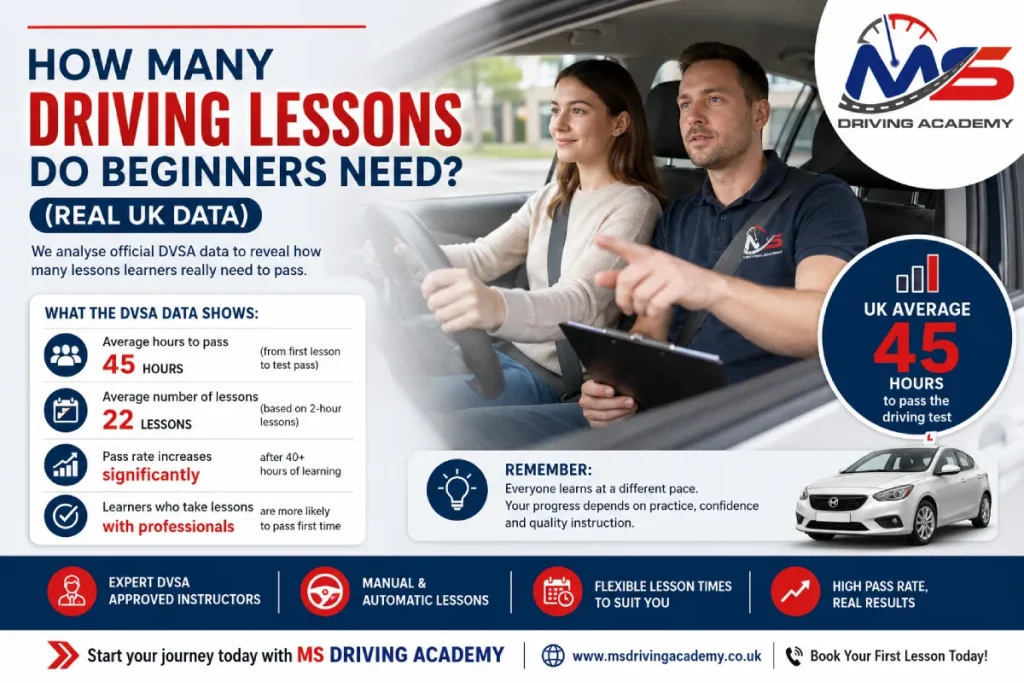
The honest answer, backed by the DVSA’s own research: the average learner needs around 45 hours of professional driving lessons plus 22 hours of private practice to reach test standard. That is the official figure behind the DVSA’s “Ready to Pass” campaign, and it has held steady for years because it reflects what actually happens on the road, not what anyone wishes were true.
But “45 hours” on its own is not that useful. What does it cost? Why do some people pass in 25 hours while others need 60? How do you know where you sit? That is what this guide answers, with real numbers rather than reassurance.
The official numbers, and one stat most people miss
Three figures worth knowing before you book anything:
- 45 hours of lessons with a professional instructor is the DVSA’s average for learners who reach test standard.
- 22 hours of private practice on top, with a family member or friend supervising, is the other half of that average.
- Learners who combine lessons with private practice are around 50% more likely to pass their practical test, according to DVSA research. That last one is the stat almost nobody quotes, and it is arguably the most useful on this page.
One more thing worth being clear about: there is no legal minimum. Nothing stops you booking a test after ten hours. The examiner does not ask how many lessons you have had. They ask, in effect, whether you can drive safely and independently for about 40 minutes. The hours are simply what it typically takes to get there, and with the national pass rate sitting at 48.7% in 2024/25, roughly half of candidates find out the hard way that they booked too soon.
What learners actually take: the realistic ranges
The 45-hour figure is an average, which means real learners are spread all around it. Based on what instructors see week in, week out, the ranges look like this:
| Learner profile | Typical hours of lessons |
|---|---|
| Quick learner, some prior experience (private land, go-karts, driving abroad) | 20 to 30 |
| Typical complete beginner | 40 to 50 |
| Nervous learner, or long gaps between lessons | 60 or more |
None of these is a grade. A 60-hour learner who passes first time has spent less money than a 30-hour learner who rushes, fails twice, and pays for two retests plus top-up lessons in between. More on that maths below.
What it costs: the sums nobody shows you
Lesson prices in the UK typically run £30 to £40 an hour. At MS Driving Academy it is £35 an hour, or £320 for a 10-hour block, which brings the effective rate down to £32. Here is what the realistic ranges cost at our prices, using block bookings:
| Hours | Cost at £32/hr (blocks) |
|---|---|
| 30 hours | £960 |
| 45 hours (the DVSA average) | £1,440 |
| 60 hours | £1,920 |
Add the fixed costs on top: £34 for your provisional licence, £23 for the theory test, and £62 for a weekday practical test (£75 evenings and weekends). So a typical beginner taking the average route is looking at roughly £1,550 to £1,600 all in, provided they pass first time.
That last clause is where the real money hides. Fail, and you pay the test fee again, wait weeks for a new slot, and usually add five to ten lessons to stay sharp, easily another £250 to £400. This is why “how few lessons can I get away with?” is the wrong question. The cheap route is being genuinely ready the first time.
The free way to cut your lesson count
Remember that 50% stat. Private practice is the closest thing learning to drive has to a cheat code, and it costs nothing but a supervising adult’s time.
The rules: your supervisor must be at least 21 and have held a full licence for at least 3 years, the car needs learner insurance covering you, and you display L plates. Then every hour spent practising what your instructor has already taught you (not learning new things, reinforcing existing ones) is an hour you do not pay £35 for. The DVSA’s 22-hour figure is not a suggestion for keen learners. It is half the recipe.
No access to a car or a willing adult? You are far from alone, especially in London where plenty of households do not run a car. It just means your professional hours carry the full load, so consistency matters even more: two lessons a week beats one, because you stop spending the first ten minutes of each lesson warming back up.
What the hours actually look like, stage by stage
A rough map of a typical beginner’s journey, so you can tell whether you are ahead, behind, or exactly where most people are:
Hours 1 to 10: control. Cockpit drill, moving off and stopping, steering, clutch control if you are in a manual. By hour ten most learners can drive on quiet residential roads without the instructor touching anything.
Hours 10 to 25: roads. Junctions, roundabouts, traffic lights, lane discipline, busier roads. This is the long middle where progress can feel slow because every situation is new. It is not slow. It is the bulk of the syllabus.
Hours 25 to 40: independence. Manoeuvres (bay parking, parallel parking, pulling up on the right), dual carriageways, driving to sat nav directions, and handling situations without prompts. Your instructor talks less and less. That silence is the progress.
Hours 40 and up: test polish. Mock tests under real conditions, tidying recurring faults, and building the consistency an examiner needs to see. When you can pass your instructor’s mock tests reliably, you are ready to book the real thing. In the MS Smart Drive app you can see this progression tracked lesson by lesson, so “am I ready?” becomes something you can check rather than guess.
What moves your number up or down
Five factors do most of the work:
Lesson frequency. The single biggest one instructors control for. Weekly-or-better learners keep momentum; fortnightly learners relearn. Two hours a week is the sweet spot for most people.
Private practice. Covered above. Worth repeating anyway.
Manual or automatic. Automatic learners often need somewhat fewer hours because the clutch and gears are off the syllabus. Mind the trap though: in 2024/25 automatics had a 44% pass rate against 50% for manuals, largely because some automatic learners book their test before their observation and judgement have caught up. Fewer hours, not fewer standards.
Nerves. Anxious learners need more time, and that is fine. A patient instructor and a calm early environment shrink the gap more than any technique does.
Where you learn. Learning around Barking and East London means heavy traffic, complex junctions and the A13 from early on. It can add a few hours at the start compared with learning in a quiet market town. It also produces noticeably more road-ready drivers, which is the actual point.
Frequently asked questions
Is there a minimum number of lessons before I can take my test?
No. There is no legal minimum. You can book your practical test as soon as you have passed your theory test. The DVSA’s 45-hour figure is an average of what learners actually need, not a rule.
Can I pass with 20 hours of lessons?
Some people do, usually those with prior experience behind the wheel and regular private practice. For a complete beginner, 20 hours is rarely enough, and failing costs more than the lessons you skipped.
How many lessons a week should I take?
One or two. Two one-hour lessons, or one two-hour lesson, keeps skills fresh without overloading you. Long gaps are the enemy: skills fade and you pay to relearn them.
Do intensive courses cut the total hours?
Not really. They compress the same hours into days or weeks rather than months. An intensive course suits you if you have a deadline and can commit full days, not if you are hoping to need less teaching.
How do I know when I’m ready to book my test?
When you can drive independently for 40 minutes or so, handle manoeuvres consistently, and pass mock tests without prompts. Your instructor will tell you honestly, and with MS Driving Academy you can see your progress in the MS Smart Drive app rather than taking anyone’s word for it.
The short version
Plan for around 45 hours of lessons if you are starting from zero. Add private practice if you possibly can, because it halves nothing but roughly doubles your odds. Budget about £1,500 to £1,600 all in at typical London prices, and treat “ready” as something you measure, not something you feel on a hopeful morning.
Ready to find out where you would sit on the curve? Your first lesson doubles as an assessment: your MS Driving Academy instructor will give you an honest estimate of your hours after seeing you drive, and you can track every step from there in the app. Lessons are £35 an hour, £320 for a 10-hour block, across Barking and East London.
Book Your First Lesson · Download the MS Smart Drive App

Shurat Rahman is a DVSA Approved Driving Instructor (ADI) at MS Driving Academy, with three years’ experience teaching manual and automatic lessons across Barking, Ilford and East London. He regularly prepares learners for practical tests at Goodmayes, Chingford, Wanstead, Loughton and Hornchurch.