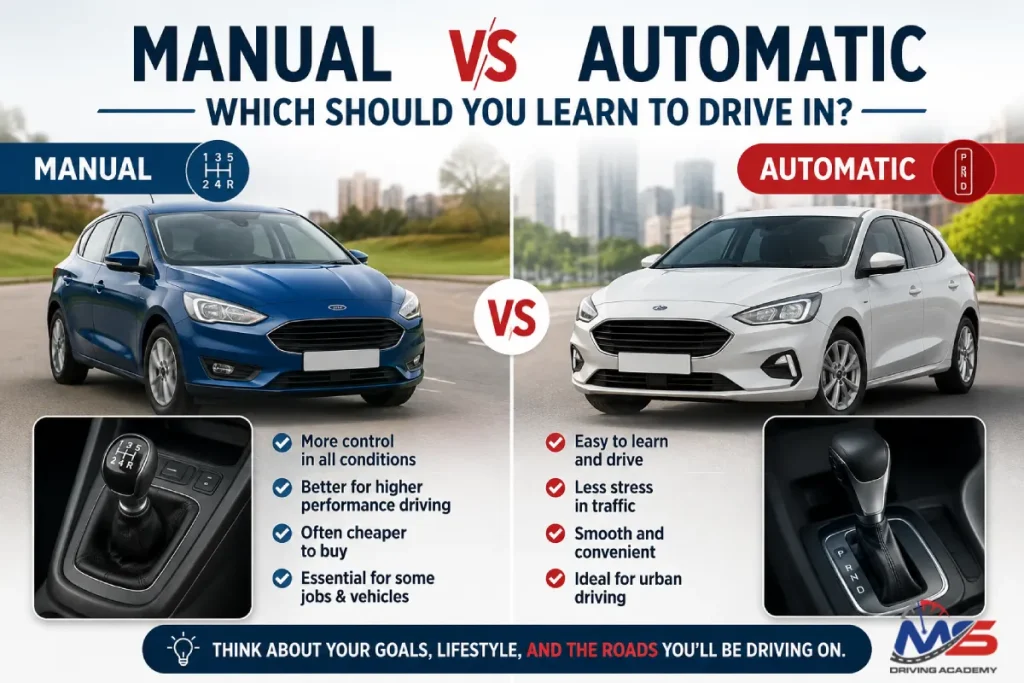
Here is the short answer. Learn in a manual if you want a licence that lets you drive any car, manual or automatic, and you are happy to put in a bit more practice early on. Learn in an automatic if you want a calmer, simpler start, you only plan to drive automatics or electric cars, or the clutch is the thing putting you off learning at all. Both get you a full driving licence. The difference is what you can drive afterwards, and how the learning feels along the way.
Most guides bury that decision under 2,000 words of preamble. We would rather you had it up front. Now let us walk through what actually sits behind the choice, so you can pick with confidence rather than guess.
The one difference that matters most: your licence
Everything else on this page is preference. This part is a rule.
Pass your test in a manual car and you earn a full manual licence, which lets you drive both manual and automatic vehicles for the rest of your life. Pass in an automatic and you get an automatic-only licence, which restricts you to automatics. Want to drive a manual later? You would need to sit another practical test in a manual car (more on that below, because it is easier than it sounds).
So the real question is not “which is easier”. It is “how much flexibility do I want to lock in?” A manual keeps every door open. An automatic trades some of that flexibility for a gentler ride to your licence.
What each is actually like to learn
Learning in a manual
A manual asks you to do more with your hands and feet. You will learn clutch control, find the biting point, change gears, and manage hill starts without rolling back. For the first couple of hours it can feel like patting your head and rubbing your stomach at the same time. Then it clicks, usually faster than learners expect, and it becomes muscle memory you never think about again.
The trade-off is those early hours. Stalling at a busy junction with cars behind you is the classic manual-learner nightmare, and nearly everyone does it at least once. A good instructor plans for exactly that, starting you somewhere quiet until the clutch feels natural.
Learning in an automatic
An automatic strips the job back to two pedals: go and stop. The car handles the gears. That frees up all the attention you would have spent on the clutch and lets you put it into the things that actually keep you safe, like mirrors, road position, and reading what other drivers are about to do.
For nervous learners, or anyone who has started and stopped learning before, that lighter mental load is a genuine relief. It also shines in stop-start traffic, which, if you are learning around East London, is most of the day. No clutch means no left-leg ache crawling along the A13 at rush hour.
Does one have a better pass rate?
Yes, and the honest answer surprises people. In 2024/25, 50% of manual tests ended in a pass, against 44% for automatics, with the overall UK car pass rate sitting at 48.7% (the highest it has been since 2017/18). So the “easier” car has the lower pass rate. What is going on?
It is not the gearbox. It is preparation. Learners often choose automatic expecting to need far fewer lessons, then book their test before they are truly ready. The examiner holds you to the same standard either way. Clutch control is just one item on a long list that also includes observation, junctions, manoeuvres and independent driving, and those are where most tests are won or lost. Manual learners tend to spend more time behind the wheel getting there, which quietly helps their pass rate too.
The takeaway: automatic can absolutely get you to test standard, sometimes in fewer hours, but only if you treat it as proper preparation rather than a shortcut. Passing is about judgement, not gears.
What about cost?
Hourly rates are usually similar for both. At MS Driving Academy, a lesson is £35 an hour whether you learn manual or automatic, so the price does not force your hand. Some schools charge a pound or two more for automatic, largely because there are fewer automatic instructors around, but the gap is small.
Where the real money moves is in how many lessons you need, and that depends far more on you than on the transmission. If an automatic gets you test-ready in fewer hours, your total spend could come out lower even at the same rate. If you rush it and fail, a retest plus extra lessons wipes that saving out. Preparation is the budget, not the badge on the boot.
The electric-car question
This is the part that makes people lean automatic, so it is worth getting the facts right, because a lot of articles have not kept up.
Under current UK policy, the sale of new pure petrol and diesel cars will be phased out from 2030. New hybrids can still be sold until 2035, and from 2035 every new car sold must be fully zero-emission. Crucially, none of this bans the car you already own: you can keep buying, driving and selling used petrol and diesel cars for years beyond those dates.
Here is why it matters for your lessons: almost every electric car is automatic, because an EV has no clutch or gearbox to speak of. As the country shifts towards electric, automatics are becoming the norm. Around 26% of all driving tests are now taken in automatics, up from under 7% a decade ago. If you are certain your driving future is electric, learning automatic makes sense.
But do not let the 2030 headline stampede you. Millions of used manual cars will be on the road well into the 2040s, cheaper to buy and cheaper to insure than most EVs. A manual licence covers you for all of them and for automatics too. If you want the safest bet against an uncertain future, manual is still the one that leaves nothing off the table.
Can I switch from automatic to manual later?
Yes, and it is less painful than most people fear. Your theory test pass does not expire the moment you get an automatic licence, and you do not repeat it. To upgrade, you take some manual lessons to learn the clutch and gears, then sit a practical test in a manual car. Pass, and your licence upgrades to full manual.
So an automatic-only licence is not a locked box. It is more of a “for now” decision. Worth knowing if you are tempted by automatic but nervous about closing off manual forever.
So which should you choose?
Match yourself to the situation that fits best:
| Choose manual if… | Choose automatic if… |
|---|---|
| You want to drive any car, including hire cars, work vans and friends’ cars | You only plan to drive automatics or an electric car |
| A job in delivery, trades or driving might be on the cards | The clutch is the main thing making you anxious about learning |
| You want maximum flexibility and resale choice | You want a calmer, simpler learning experience |
| You do not mind a slightly steeper start | You mostly drive in heavy town and city traffic |
| You want the widest, cheapest choice of used cars | You want to focus fully on observation and road skills |
Still torn? A single assessment lesson usually settles it. Feeling the clutch for an hour tells you more than any article can.
Learning to drive around Barking and East London
Our instructors teach both, every week, and the pattern we see locally is simple. Nervous learners and those who mainly drive in busy East London traffic often thrive in an automatic, because it takes one big worry off the table. Learners eyeing delivery work, a trade, or just maximum freedom tend to go manual and never regret the extra flexibility. Neither is “better”. The right one is the one that fits your plans.
Whichever you pick, MS Driving Academy charges the same £35 an hour, our DVSA-approved instructors teach both, and you can track your progress in the MS Smart Drive app. If you are genuinely unsure, tell us when you book and we will point you the right way after your first lesson.
Frequently Asked Questions
Is it easier to pass in an automatic?
Not according to the numbers. In 2024/25, automatics had a 44% pass rate against 50% for manuals. Automatics are simpler to operate, but the test judges observation, junctions and manoeuvres just as hard, so preparation matters more than transmission.
Is automatic more expensive to learn in?
Usually only slightly, if at all. At MS Driving Academy it is the same £35 an hour as manual. Your total cost depends mostly on how many lessons you need, which comes down to you, not the gearbox.
Can I drive a manual car with an automatic licence?
No. An automatic-only licence restricts you to automatic cars. You would need to pass a further practical test in a manual to upgrade (your theory pass still counts).
Are automatic cars the future?
Increasingly, yes. New pure petrol and diesel cars are being phased out from 2030, and almost all electric cars are automatic. But used manuals will be around for decades, so a manual licence stays useful for a long time yet.
Which is better for a nervous driver?
Automatic, for most people. Removing clutch control and the fear of stalling lets nervous learners focus on the road and build confidence faster.
Ready to start?
You do not have to decide alone. Book your first lesson with MS Driving Academy, tell us you are weighing up manual against automatic, and your instructor will help you choose based on how it actually feels behind the wheel. Lessons are £35 an hour either way, with DVSA-approved instructors across Barking and East London.
Book Your First Lesson · Download the MS Smart Drive App

Shurat Rahman is a DVSA Approved Driving Instructor (ADI) at MS Driving Academy, with three years’ experience teaching manual and automatic lessons across Barking, Ilford and East London. He regularly prepares learners for practical tests at Goodmayes, Chingford, Wanstead, Loughton and Hornchurch.